Tag: Analytics alternatives
All blog posts with this tag.
- 04 Mar, 2026
Piwik PRO kills its free plan: deadline extended to March 31, but the end is final
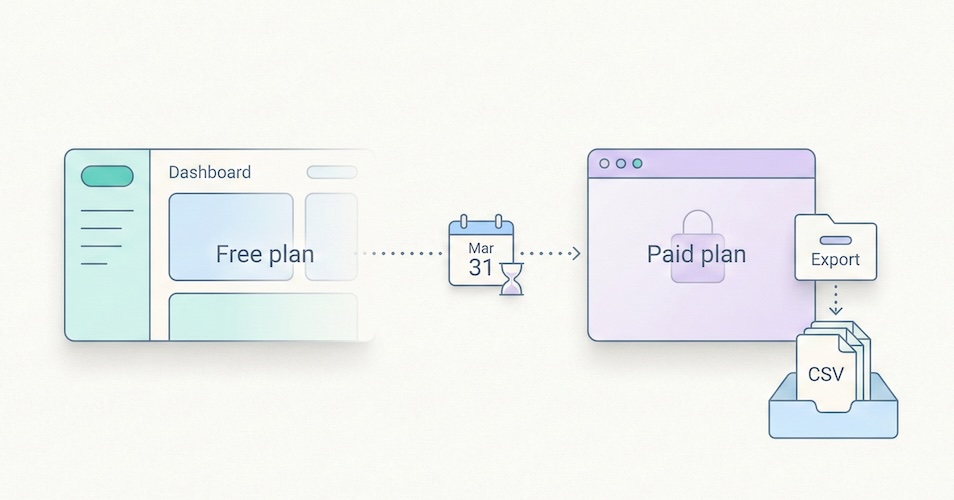
February 28, 2026 was supposed to be the deadline. Piwik PRO was ending its free Core plan, forcing users to either upgrade or find something else. Then, on March 3 -- three days after that date -- the company emailed its users with a one-month extension: the new deadline is March 31, 2026. The company cited the volume of users who had reached out asking for more time, and wanted to ensure everyone had a fair chance to preserve their data. One more month. But Piwik PRO is explicit: no further extensions will be granted. The Core plan is gone -- this extra time only changes the schedule, not the decision that needs to be made. For the tens of thousands of organisations that relied on this tool, the core message is unchanged: move to the Business plan at €35/month, or look elsewhere. The extension buys time; it changes nothing fundamental. This matters. Piwik PRO was one of the few analytics platforms to combine serious GDPR compliance, European hosting, and free access. Its Core plan represented a credible entry point into privacy-first analytics for SMEs, agencies, and independent developers -- without budget approval processes or finance negotiations. That door closes in a month. And it illustrates something many overlook: a freemium without a viable business model doesn't eliminate costs -- it defers them. What Piwik PRO offered for years without sustainable funding had to be paid for eventually. Now it is -- seven years late. This article covers what happened, why it matters, and which serious alternatives exist if your organisation was on the Core plan.What happened: the full timeline August 2025: the official announcement In August 2025, Piwik PRO announced a complete pricing overhaul. The free Core plan -- available since the platform's commercial launch -- would be discontinued. A new two-tier structure (Business and Enterprise) would apply to new accounts from August 4, 2025, and to existing Core accounts from December 2025. The stated rationale: delivering a unified platform combining analytics, tag management, consent management, and data activation. In practice, Piwik PRO decided to pivot toward a more complex, integrated offering that couldn't coexist with a freemium model. December 2025: forced migration In December 2025, all free Core accounts were transitioned to the Business plan. Existing users were offered transition discounts to soften the move. The underlying message was unchanged: the free tier is over. February 28, 2026: the first deadline February 28 arrived. Piwik PRO's website displayed a persistent banner: "Free Core plan ends February 28. Existing users must upgrade to Business or Enterprise plan before this date to preserve data and continue tracking." March 3, 2026: a one-month extension under pressure Three days later, Piwik PRO emailed Core users. User pressure had clearly played a role -- many had contacted the company saying they needed more time to complete their migration. The new deadline is March 31, 2026. Piwik PRO specifies this is the final deadline, with no further extensions. The scale: 28,000 organisations affected According to the same email, over 28,000 organisations had been using the free Core plan since its launch. That figure shows how widely adopted the plan had become -- and how significant the disruption is for a meaningful portion of Europe's analytics ecosystem. The fact that an extension was necessary confirms many hadn't anticipated the urgency.The economics of freemium: why this model always breaks Google Analytics created an impossible expectation Google Analytics being free is not generosity. It's a business model: you pay with your data and your visitors' data, which feeds one of the largest advertising ecosystems in the world. This implicit contract is documented, contested, and at the root of most analytics-related GDPR enforcement across Europe over the past several years -- from the French CNIL to the Austrian DSB, the Italian Garante, and the Irish DPC. But that free tier created a market expectation: analytics should be free. Every startup positioning itself as a "privacy-first alternative to Google Analytics" had to respond to that expectation -- by offering at least a freemium tier to lower the barrier to entry. Piwik PRO did. Plausible did it through its self-hostable open source model. Matomo still does with its self-hosted version. Piwik PRO chose a different game The decision to remove the free tier reflects a clear strategic repositioning. Piwik PRO is no longer pursuing SMEs with an accessible entry-level offer. It's targeting mid-to-large organisations in regulated sectors -- healthcare, finance, public sector -- that need a unified platform: analytics, tag management, consent, data activation. Analyst Brian Clifton, who joined Piwik PRO's advisory board in 2025, made this point clearly in his July 2025 analysis: only companies of the scale of Google, Microsoft, or Meta can sustainably fund a large-scale freemium model. Smaller vendors need to find their own path -- and that path often means abandoning free tiers. The real cost of the switch For an organisation on the Core plan, moving to Business means a minimum of €35/month, or €420/year. That's the entry price; the actual bill depends on the number of domains and data volumes involved. For a larger company, that's manageable. For a small NGO, a solo consultant, or a side project, it's a budget line that didn't exist before and now needs to be justified. And for organisations running multiple domains, the costs quickly exceed the entry tier.What Piwik PRO Core offered -- and what you'll need to rebuild What the Core plan actually delivered The free Core plan wasn't trivial. It included features that few free tools offered at this compliance level: European hosting (Elastx infrastructure in Sweden), integrated consent management, no advertising data resale, an included tag manager, and 500,000 monthly actions -- more than enough for most SME sites. It was, in short, enterprise-grade tooling at no cost. That paradox had a limit, and that limit has now been reached. What the Business plan adds Piwik PRO isn't just removing the free tier. The Business plan brings concrete improvements: data retention increases from 14 to 25 months. Dashboards, reports, configurations, and historical data all carry over intact during migration. EU-first hosting via Elastx in Sweden is guaranteed across all plans. For organisations that had already invested time in Piwik PRO configuration, migrating to Business may be rational -- budget permitting. Three paths forward If you were on the Core plan, you have three options before March 31: Option 1: migrate to the Business plan at €35/month. The simplest path if Piwik PRO meets your needs and the budget is there. Everything carries over. Data retention improves significantly. Option 2: switch to self-hosted Matomo. Matomo Analytics remains open source and free to self-host. You manage infrastructure, updates, and security yourself. Viable for technical teams, but the indirect cost in time and expertise is consistently underestimated. Option 3: adopt a lighter, simpler analytics tool. If you didn't actually need Piwik PRO's full feature set -- advanced tag management, CDP, data activation -- more accessible alternatives exist. This is where the frugal analytics market becomes relevant.A map of serious alternatives Plausible Analytics: accessible open source Plausible is European (Estonia-based), open source, and starts at €9/month for 10,000 page views. Its script weighs ~1 KB versus ~45 KB for GA4. It's cookieless by default -- meaning no consent banner required under most configurations, and a straightforward path to compliance under GDPR and the ePrivacy Directive across European jurisdictions. Its limit: no native consent management or tag manager. If you relied on those features in Piwik PRO, you'll need to handle them separately. Fathom Analytics: simple and compliant Fathom, US-hosted with an EU option, starts at $15/month for 100,000 page views. Its positioning is explicitly around simplicity and compliance. No cookies, no fingerprinting. A solid option, though costs scale quickly with traffic volume. Simple Analytics: unlimited retention as a differentiator Simple Analytics (Netherlands-based) starts at $19/month for 100,000 datapoints with unlimited data retention. That last point is meaningful for organisations coming from Piwik PRO Core, where retention was capped at 14 months. If you care about multi-year trend analysis, this is a notable advantage. Pirsch Analytics: the budget-friendly German option Pirsch, based in Germany, starts at €5/month for 10,000 page views -- one of the lowest entry points for a European-hosted, privacy-first tool. Less well-known, but functionally sufficient for common use cases. Comparison tableTool Entry price Volume included EU hosting Cookieless by defaultPiwik PRO Business €35/month Variable (actions) Yes (Elastx/Azure) No (banner often required)Plausible €9/month 10k page views Yes YesFathom ~€14/month 100k page views Optional YesSimple Analytics ~€18/month 100k datapoints Yes (NL) YesPirsch €5/month 10k page views Yes (DE) YesMatomo self-hosted Infrastructure cost Unlimited Depends on host No (banner often required)The picture is clear. The end of Piwik PRO Core opens up a market segment. Organisations that never considered paying for analytics are now comparing options between €5 and €35/month -- and many will find that simpler, lighter, cheaper alternatives cover their actual needs. Our comparison of Google Analytics, Matomo, and frugal analytics goes deeper if you want a more thorough evaluation.What this episode reveals about the analytics market Unsustainable freemium: a model that always breaks Piwik PRO Core's end isn't an accident. It's the logical conclusion of a specific business model: large-scale freemium without sustainable funding, where free access serves as an acquisition lever without a clear path to profitability. Two very different forms of "free" are worth distinguishing here. The first is data-funded free: Google Analytics can afford to be free because your visitors' data fuels an advertising ecosystem worth hundreds of billions of dollars. That implicit contract is documented, challenged, and the root cause of most analytics-related GDPR enforcement by European data protection authorities -- including decisions by the CNIL (France), DSB (Austria), Garante (Italy), and others under both GDPR and the ePrivacy Directive. Our guide on GDPR-compliant analytics and consent exemptions covers the regulatory landscape in detail. The second is structured free: a deliberately limited free tier, backed by a transparent business model where monetisation is explicit -- on volume, on team features, on complementary services. This approach is honest and viable; it respects users because it doesn't trap them. Piwik PRO Core belonged to neither category. It was a generous free plan -- no meaningful volume constraints, no obvious conversion lever -- funded by investors hoping to convert users to Enterprise eventually. When that funding reaches its limit, forced migration is inevitable. Small organisations take the biggest hit Piwik PRO's decision hits smaller organisations hardest. A large enterprise on an Enterprise plan is unaffected by the end of Core. A cultural association, a five-person consultancy, or an independent e-commerce operator who installed Piwik PRO because it was "free and GDPR-compliant" now faces a choice they hadn't planned for. This is exactly what frugal analytics is designed to address: simple tools, honest business models, calibrated for real needs rather than for features 90% of users will never touch. Our article on 5 essential KPIs for a frugal analytics dashboard illustrates what "measuring what matters" looks like in practice. A signal for the whole ecosystem Piwik PRO Core's end sends a clear signal: large-scale freemium without a coherent business model isn't a durable strategy. The privacy-first analytics tools that will survive and grow are those that build transparent business models with honest value propositions -- not those that use free access as an acquisition mechanism before forcibly repricing. For users, this means one question is worth asking before adopting any tool: how is it funded if I'm not paying? A limited free tier backed by explicit, coherent monetisation is structurally reliable. A generous freemium with no visible path to profitability is not.What to do before March 31 Export your historical data now. Before anything else, recover your data even if you haven't decided on your next tool. Piwik PRO offers CSV exports from the dashboard. Don't lose what you've built. Audit your actual usage. Did you actually use the tag manager, CDP, and integrated consent management? Or mainly core metrics -- visits, page views, traffic sources, conversions? If it's the latter, significantly simpler and cheaper alternatives will cover your needs. Compare total cost of ownership, not just entry price. A €9/month tool you understand and actually use is worth more than a €35/month tool where you're using 10% of the features. Factor in configuration time, learning curve, and ongoing maintenance. Review your compliance posture. This transition is also a prompt to reassess your analytics setup against GDPR and ePrivacy requirements. Our 10-point GDPR analytics checklist lets you quickly identify whether your new configuration is compliant -- or needs adjustment.Conclusion Piwik PRO's extension to March 31, 2026 gives organisations that weren't ready a useful window. But it doesn't change what needs to happen: the free Core plan is ending, and the decision needs to be made in the next four weeks. This is also an opportunity. After years of using a tool "because it was free," this disruption forces a straightforward question: what do I actually need to run my business? The answer is often more modest than Piwik PRO -- or GA4 -- led you to believe. The underlying issue deserves a dedicated exploration. In an upcoming article, we'll examine what a genuinely ethical analytics model looks like: basic analytics accessible for free, monetisation tied to growth and team usage, no data exploitation, no pricing traps. If that approach resonates and you're looking for a simple, privacy-first tool with an honest business model, you can join the Pomelo Analytics waitlist.FAQ What is the new deadline for Piwik PRO Core users? Piwik PRO announced on March 3, 2026 a one-month extension of its original February 28 deadline. The new final deadline is March 31, 2026. The company has explicitly stated that no further extensions will be granted. Why did Piwik PRO remove its free plan? Piwik PRO cited the goal of delivering a unified platform combining analytics, tag management, consent management, and data activation. In practice, the freemium model was incompatible with the platform's upmarket pivot. The company now targets mid-to-large organisations in regulated industries, where enterprise pricing is more appropriate. Was the Piwik PRO Core plan genuinely GDPR-compliant out of the box? Not automatically. Piwik PRO Core could be configured for GDPR compliance, but required careful setup. The platform uses cookies, meaning a consent banner was typically required. Compliance depended on how the integrated consent manager was configured by each account administrator. What serious free alternatives exist to replace Piwik PRO? The only genuinely serious free alternative is self-hosted Matomo Analytics. It's free as software but requires hosting and technical maintenance. For organisations without in-house technical expertise, low-cost paid alternatives -- Plausible at €9/month, Pirsch at €5/month -- offer a better cost/simplicity balance than a poorly maintained Matomo installation. Could this happen with other privacy-first analytics tools? Yes, but the distinction matters. The risk is highest for tools offering generous free tiers without sustainable funding -- like Piwik PRO Core. A deliberately limited free tier, backed by transparent monetisation (volume, team features, advanced capabilities), is structurally stable. The question to ask isn't "is there a free plan?" but "how is this tool funded if I'm not paying?" Business model transparency is a selection criterion in its own right.SourcesPiwik PRO, "Here's our new pricing structure", August 2025 (https://piwik.pro/blog/new-pricing-structure/) Piwik PRO Community, "Will the free Piwik Pro remain active after February 2026?", August 2025 (https://community.piwik.pro/t/will-the-free-piwik-pro-remain-active-after-february-2026/5300) Brian Clifton, "Piwik PRO Ends Freemium: My Take", July 2025 (https://brianclifton.com/blog/2025/07/03/piwik-pro-ends-freemium-my-take/) R-bloggers / rstats-tips.net, "Piwik Pro doesn't offer a free plan anymore", September 2025 (https://www.r-bloggers.com/2025/09/piwik-pro-doesnt-offer-a-free-plan-anymore/) Piwik PRO, "Business Plan" official page (https://piwik.pro/business-plan/) European Alternatives, Piwik PRO listing (https://european-alternatives.eu/product/piwik-pro) Piwik PRO, email to Core users announcing the deadline extension, March 3, 2026