
Tag: Ethical marketing
All blog posts with this tag.
- 09 Feb, 2026
Trust and targeting: which customer data do you need?
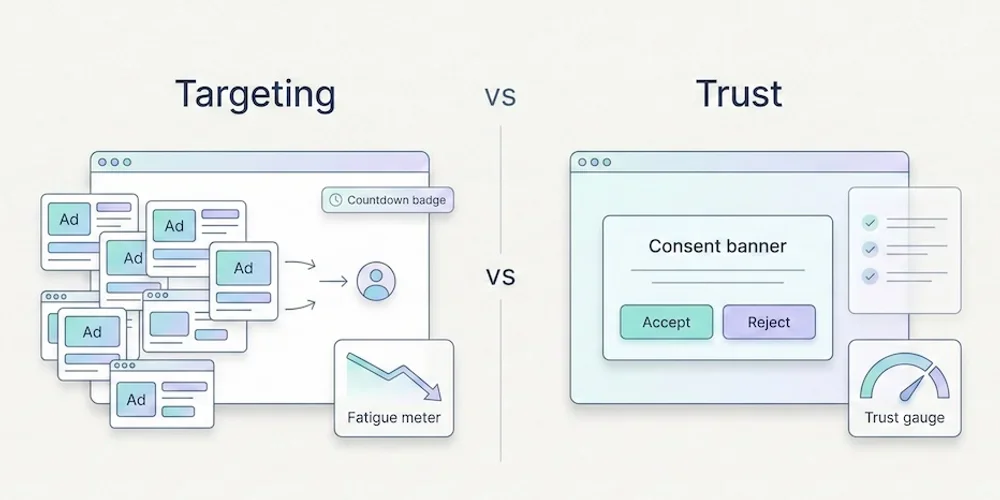
Respecting privacy does not guarantee a conversion increase. The stronger argument is more pragmatic: trust is becoming part of the buying experience, and intrusive data practices can create friction that teams do not always measure. For European SMEs, B2B SaaS teams and agencies, this matters because growth depends on repeated interactions. A buyer may discover you through content, compare you over several visits, ask colleagues, read docs and return later. If every interaction asks for information without a clear benefit, the relationship weakens before sales even starts. What trust changes operationally Trust does not mean collecting no data. It means collecting data with a clear purpose, explaining it plainly and avoiding silent escalation from measurement to targeting. This approach affects five everyday practices:analytics: measure what the team actually uses; forms: ask only for fields needed at that stage; advertising: separate measurement from retargeting; content: answer real buyer questions instead of hiding value behind gates; reporting: explain limits instead of pretending every number is perfect.Why targeting can become expensive Targeting can be useful when it is transparent, proportionate and aligned with user expectations. It becomes expensive when it drives:consent friction; duplicated tags; heavier pages; lower trust in forms and demos; persistent disagreements over attribution; extra legal and vendor review.These costs rarely appear in ad-platform dashboards. They show up as longer sales cycles, more implementation work and weaker confidence in the numbers. A practical trust checklist Before adding a new tracking or targeting feature, ask:What decision will this data support? Can we answer the same question with less data? Will the visitor understand why this happens? Is this audience measurement, or marketing steering with consent? Who will review whether the data is still useful in three months?If the team cannot answer, delay the feature. Start with the data your team needs Before adding tracking, define the decision it will support. Then identify the necessary data, who may access it and how to explain its collection to visitors. Collecting less does not guarantee more sales. It helps remove measurements nobody uses and document the ones that guide your team’s work. SourcesCisco, 2025 Data Privacy Benchmark Study, April 2, 2025: https://investor.cisco.com/news/news-details/2025/Ciscos-2025-Data-Privacy-Benchmark-Study-Privacy-landscape-grows-increasingly-complex-in-the-age-of-AI/default.aspx Cisco, 2025 Data Privacy Benchmark Study PDF: https://www.cisco.com/c/dam/en_us/about/doing_business/trust-center/docs/cisco-privacy-benchmark-study-2025.pdf Edelman, 2025 Trust Barometer: https://www.edelman.com/trust/2025/trust-barometer Edelman, 2025 Brand Trust special report: https://www.edelman.com/trust/trust-barometer

Just the right measure, for all your websites.
Pomelo is opening gradually. Join the first teams measuring right and help shape what comes next.