Tag: Trust
All blog posts with this tag.
- 30 Mar, 2026
Why Trust Converts Better Than Targeting
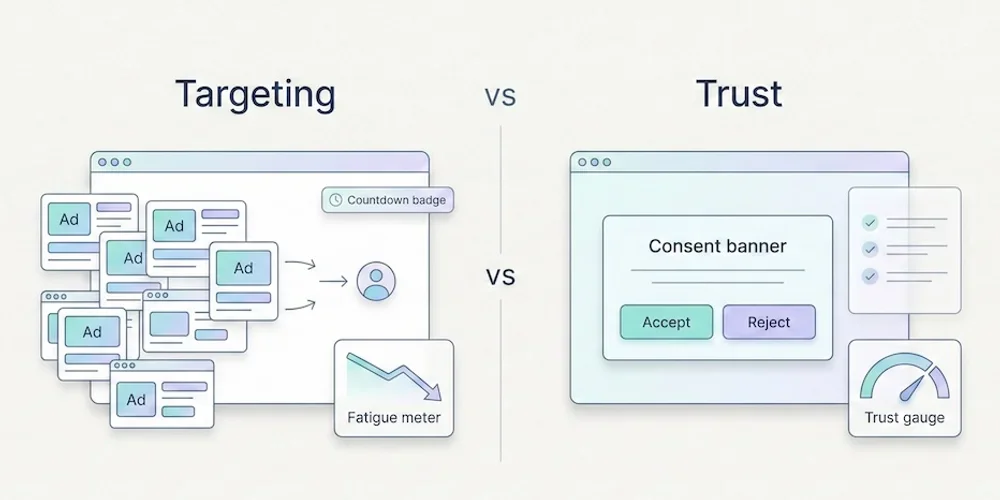
You see that ad following you across the web? The one showing exactly the product you looked at three days ago, on five different sites, with a countdown "Only 4h left to get the offer"? You might have clicked it. Maybe even bought. But did you feel good doing it? Modern marketing rests on a simple belief: the more precise the targeting, the higher the conversion. The more you know about your audience (age, location, purchase behaviors, interests, sites visited), the more you can personalize the message, the more you sell. It's mathematical. It's effective. It's measurable. It's also collapsing. Not because targeting no longer works technically. But because consumers have figured out the game. They install ad blockers (42% of French internet users in 2025, according to Statista). They systematically refuse cookies (87% click "Reject All" when the button is visible, according to a 2025 CNIL study). They choose Safari or Firefox that block tracking by default. And above all, they no longer trust. Meanwhile, another approach emerges. Brands betting on transparency rather than tracking. Who clearly explain what they do with your data (or rather, what they don't do). Who respect you instead of manipulating you. And who, counter-intuitively, get better results: higher conversion rates, lower customer acquisition cost, stronger retention. This article shows you why trust has become the new marketing KPI. With numbers, studies, concrete cases. Because ethical marketing isn't a moral stance. It's a more profitable business strategy. The Personalization Paradox: Why More Targeting = Less Conversion Ad Fatigue Is Measurable You know that feeling. You browse an e-commerce site, look at a product, close the tab. Then, for three weeks, that product follows you everywhere. Facebook. Instagram. News sites. Blogs. Always the same visual. Always the same "-20% today only." It's advertising retargeting. Technically, it should work: you showed interest, they remind you of the product, you eventually buy. Except data shows the opposite. An Adobe 2024 study (Digital Trends Report) reveals 68% of consumers find personalized advertising "disturbing" rather than "useful." More worrying for advertisers: 71% say a brand following them too much becomes "repulsive," and 47% admit having deliberately chosen a competitor after feeling "harassed" by aggressive retargeting. Ad fatigue isn't just an impression. It's measured in metrics:Click-through rate (CTR) declining: Between 2019 and 2025, average display banner CTR dropped from 0.46% to 0.19%, according to Google Display Benchmarks 2025. Cost per click (CPC) rising: To compensate for declining engagement, advertisers overbid. Average Facebook Ads CPC increased 89% between 2020 and 2025 (source: WordStream 2025). Conversion rate stagnating: Despite rising ad budgets, average e-commerce conversion rate has stagnated at 2.3% since 2022 (Baymard Institute 2025).Conclusion: You're spending more to reach increasingly unreceptive audiences. Return on investment (ROI) mechanically decreases. The "Creepy Factor": When Personalization Becomes Intrusive There's a threshold beyond which personalization stops being perceived as service and becomes intrusion. Marketing researchers call it the "creepy factor." Classic example: You discuss Greece vacations aloud with a friend. Next day, your Instagram feed is full of ads for Athens flights. Coincidence? Maybe. But you don't experience it as coincidence. You experience it as privacy violation. A UC Berkeley / Wharton study (2023) tested different levels of advertising personalization:Low personalization ("Discover our new products"): Neutral perception, standard click rate. Moderate personalization ("These products might interest you based on your last visit"): Positive perception, click rate +12%. High personalization ("We noticed you looked at this product 3 times this week"): Negative perception (-34% on trust scale), click rate +8% but conversion rate -22%.The paradox: Hyper-precise personalization attracts clicks (curiosity, "how do they know that?" effect), but destroys trust and reduces conversion. People click, then withdraw. They feel manipulated. Ad Audiences Degrade Rapidly Ad targeting relies on audience data quality. That quality is collapsing. Browser blocking: Safari (Intelligent Tracking Prevention) and Firefox (Enhanced Tracking Protection) block third-party cookies by default. Chrome introduced a "user choice" system amounting to the same thing. Result: In 2026, approximately 65% of web traffic is "untrackable" by classic methods (source: Statcounter + blocker analysis). Massive opt-out: 87% of users refuse cookies when a visible "Reject All" button is displayed (2025 CNIL study). Your Facebook, Google, LinkedIn ad audiences represent only 10-30% of your actual traffic. Synthetic data and modeling: To compensate, ad platforms (Meta, Google) increasingly use "modeling" (machine learning to guess conversions they can't measure). It's opaque, imprecise, and biases your decisions. Concretely: You're optimizing campaigns on partial, modeled data. You think you're targeting "women 25-34 interested in yoga," but you're actually reaching a fuzzy mix of profiles the platform estimates resemble this target. Real effectiveness is impossible to measure. Trust as New KPI: What Studies Say Edelman Trust Barometer 2025: Trust Determines Purchase Edelman's Trust Barometer, the global reference on brand trust, publishes striking data annually. 2025 edition (survey of 32,000 people in 28 countries):81% of consumers say trust in a brand is "decisive" or "very important" in their purchase decision. 67% refuse to buy from a brand they don't trust, even if the product is better or cheaper than competitors. 54% stopped buying a product after learning the brand collected or sold their personal data without clear consent.More revealing: Trust weighs more than price in 64% of B2C purchase decisions, and 71% in B2B. In other words, people accept paying more for a brand they trust. What builds this trust? Three dominant factors:Data transparency (78% of respondents): "The brand clearly explains what it does with my data." Privacy respect (72%): "I can use the service without being tracked everywhere." Values alignment (69%): "The brand acts consistently with its stated values."Aggressive ad targeting fails on all three criteria. Trust embodies them. Cisco Privacy Benchmark 2025: 60% Willing to Pay More Cisco's annual study (Consumer Privacy Survey 2025, 2,600 adult respondents in 12 countries) confirms and specifies:60% of consumers say they're willing to pay up to 10% more for a product or service from a company clearly respecting their privacy. 44% have already switched providers or canceled a purchase due to personal data concerns. 72% consider companies taking privacy seriously to be "more trustworthy in general," including on non-data aspects (product quality, customer service, overall ethics).Halo effect: Privacy respect improves overall brand perception. It's not an isolated topic, it's a signal of seriousness and respect. More interesting for marketing teams: The Cisco study shows companies investing in privacy compliance (GDPR, transparency, respectful tools) have:An average ROI of 1.8x on these investments (operational cost savings, reduced fines, increased customer trust). 23% higher customer retention (12-month retention rate). 17% lower customer acquisition cost (CAC) (word-of-mouth, organic recommendations).Privacy-first isn't a cost. It's a profitable investment. Apple, DuckDuckGo, Signal: Privacy as Competitive Advantage Some brands made privacy their main selling point. And it works. Apple: "Privacy. That's iPhone." Apple's 2021-2025 campaign positions privacy as differentiator versus Android. Measurable result:iOS market share in Europe: +4.2 points between 2021 and 2025 (source: Statcounter), while iPhone prices remain 30-40% higher than Android equivalents. 68% of 2024-2025 iPhone buyers cite "protecting my privacy" as purchase reason (Consumer Intelligence Research Partners survey).DuckDuckGo: Search engine that "doesn't track you." Global market share grew from 0.5% (2020) to 2.8% (2025) per StatCounter. Organic growth, no massive advertising. Unique argument: Trust. Signal: Encrypted messaging. 50 million monthly active users in 2025 (vs 10 million in 2020), without marketing budget, purely by recommendation. Users migrate from WhatsApp (Meta) to Signal after each data controversy. These examples show there's a massive market for brands putting trust at the center. A market that pays, recommends, stays loyal. How to Measure Trust (And Why It's More Predictive Than CTR) Privacy-Corrected Net Promoter Score (NPS) Classic Net Promoter Score asks: "How likely are you to recommend our product/service to a friend?" (0-10 scale). It's a good overall satisfaction indicator. A variant emerges: Privacy NPS. Slightly modified question: "How likely are you to recommend our company to a friend based on how we respect your personal data?" Forté Research Group study (2024, 1,200 B2B SaaS companies): Privacy NPS better predicts 24-month customer retention than classic NPS. Correlation of 0.78 vs 0.64. Why? Because data respect signals deep trust. A customer trusting you with their data will trust you long-term. A wary customer will leave at the first opportunity (competitor, price increase, incident). How to measure it:Integrate the question into post-purchase or annual surveys. Segment: Promoters (9-10), Passives (7-8), Detractors (0-6). Calculate: % Promoters - % Detractors. Correlate with business metrics (LTV, churn rate, CAC).If your Privacy NPS is negative, you have a trust problem that will eventually impact revenue. Direct Return Rate vs Retargeted Traffic Here's a simple, powerful metric: direct traffic / retargeted traffic ratio.Direct traffic: People coming to your site by typing the URL, via bookmark, or direct link (email, word-of-mouth). They know you. They chose you. Retargeted traffic: People returning because an ad followed them after their first visit.If your acquisition relies mainly on ad retargeting, you're building on sand. The day retargeting becomes too expensive or technically impossible (cookie blocking), your traffic collapses. If your direct traffic (+ organic) grows, it signals a strong brand, established trust. People choose to return. No need to chase them. E-commerce benchmark (source: Littledata 2025):E-commerce with strong brand (trust): 45-60% direct/organic traffic. E-commerce dependent on paid (targeting): 15-30% direct/organic traffic.The first group has average CAC of €28. The second, €67. Almost 2.5 times more expensive to acquire a customer when dependent on paid targeting. Lifetime Value (LTV) vs Customer Acquisition Cost (CAC) The LTV/CAC ratio is the king metric for judging acquisition model health.LTV (Lifetime Value): How much a customer brings you over their lifetime. CAC (Customer Acquisition Cost): How much you spend to acquire that customer.A healthy ratio: LTV/CAC > 3. You earn three times more than you spend. Companies betting on trust (transparency, privacy respect, honest communication) tend to:Increase LTV: Superior retention, repeat purchases, rising average basket (trust effect, "I trust them, I can buy more"). Reduce CAC: Less paid dependency, more organic recommendations, better conversion rate.ProfitWell study (2024, 2,300 SaaS companies):"High-trust" companies (high trust score, measured by NPS surveys and privacy practices): Average LTV/CAC of 4.2. "Low-trust" companies (aggressive targeting, intensive tracking, opaque communication): Average LTV/CAC of 2.1.Double. With same product quality. The difference? Trust. Five Tactics to Build Trust (And Improve Your Conversions) Tactic 1: Honest Consent Banners The consent banner (cookie banner) became a modern web symbol. And most are designed to deceive: Huge, colorful "Accept" button, tiny, grayed-out "Reject" button, hidden in submenus. Do these "dark patterns" work? Short-term, yes. You get more consents. More data. More retargeting. Medium-term, no. Users feel manipulated. Data protection authorities massively sanction these practices. And above all, you lose trust. Honest alternative:"Accept" and "Reject" buttons of identical size and color. No pre-checked boxes. Clear explanation: "We use cookies to measure our audience (without identifying you) and improve your experience. We never sell your data." "Learn more" option to a transparent page.Measured result (ConsentManager 2024 study, 450 e-commerce sites):"Dark patterns" banners: 78% consents, but bounce rate +12% on subsequent visits. "Honest" banners: 34% consents, but bounce rate -8%, average basket +€6, return rate +19%.Fewer consents, but more trust. And ultimately, more sales. Tactic 2: Transparency > Optimization Modern marketing obsesses over optimization: Constant A/B testing, dark patterns to "maximize conversions," deceptive wording to "reduce cart abandonment." Classic example: "Only 2 in stock!" (when there are 200). "127 people watching this product right now" (invented number). "Offer expires in 3h" (it never expires). These tactics work. Short-term. They create artificial urgency that pushes to purchase. But they erode trust. Once the customer discovers the manipulation (and they always eventually do), they don't return. Worse, they talk about it. Negative reviews. Social media posts. Transparent alternative:Real stock displayed: "12 units available." No fake visitor counters. Honest promotions: "-20% until March 31" (and really until March 31, not "extended" indefinitely).Paradoxical result: Immediate conversion rate may drop 5-10%. But 3-month return rate increases 30-40%. LTV explodes. Baymard Institute study (2024): E-commerce sites with "honest tactics" have 12-month customer return rate of 41%, versus 18% for those using dark patterns. Revenue difference over 12 months: +67% for "honest" ones. Tactic 3: Respectful Analytics (And Assumed) Many companies install Google Analytics by default, without thinking. Then add Facebook pixel. Then LinkedIn Insight Tag. Then Hotjar for session replay. Result: 15 tracking scripts, massive legal risks, and degraded user experience (load time, omnipresent banners). Alternative:Switch to a compliant-by-default analytics tool: Matomo, Plausible, Fathom. Cookieless, EU hosting, no US transfers. Communicate it: Add to your footer "We use Plausible to measure our audience, without cookies and without tracking you. Your data stays private. [Learn more]". Publish your stats publicly (Plausible / Matomo option): "We had 12,000 visitors this month, here's where they came from." Total transparency.Effect: You transform analytics (perceived as intrusive) into trust signal. "This company respects me enough to use an ethical tool." Use case: Basecamp (project management tool) migrated from Google Analytics to Fathom in 2019. They published a blog article explaining why. Result: +15% signups in the following month, with no other changes. People appreciated the coherence between stated values ("We don't track you") and tools used. Tactic 4: Authentic Post-Purchase Communication Most post-purchase emails look like this:Email 1 (D+1): "Thanks for your purchase! Here's 10% off your next order." Email 2 (D+3): "Did you forget something in your cart?" Email 3 (D+7): "People who bought X also liked Y."Three transactional emails, zero relationship. Customer feels like an order number. Authentic alternative:Email 1 (D+1): "Thanks for your trust. We hope you'll enjoy [product]. If you have any questions, reply directly to this email (yes, there's a human behind it)." Email 2 (D+7): "How's your experience with [product] going? We'd love to know what works and what could be improved." Email 3 (D+30): "One month after your purchase. We'd love to know how you're using [product]. No promotion today, just genuine curiosity."Human tone. No forced selling. Invitation to dialogue. Result (Klaviyo 2024 study, 800 e-commerce sites):"Classic transactional" sequence: 23% open rate, 2.1% click rate, 12% repurchase rate at 3 months. "Authentic" sequence: 41% open rate, 8.7% click rate, 28% repurchase rate at 3 months.People respond to authenticity. And they buy more. Tactic 5: Share Failures (Not Just Successes) Classic marketing only shows successes: 5-star testimonials, "+300% growth," "Product of the Year." Everything's perfect. All the time. Problem: Nobody really believes it. Everyone knows companies choose best testimonials, hide problems, embellish numbers. Vulnerable alternative: Share failures, difficulties, lessons learned too. Blog, newsletter, social media. Examples:"We botched our product launch. Here's what we learned." "Our customer service had 48h delays last week. We apologize and here's what we're implementing." "We tested this feature. Users hated it. We removed it."Counter-intuitive effect: Vulnerability creates trust. People think "This company is honest. If they admit mistakes, I can believe their successes." Use case: Buffer (social media management tool) publishes an "Open Blog" where they share revenues, hiring difficulties, product failures. Result: Extremely loyal community, 3.2% churn rate (vs SaaS average of 5-7%), strong organic growth (60% of traffic from recommendations). Privacy-First ROI: Simplified Calculation for Your Situation Before Scenario: Paid Targeting Dependency Let's take a typical e-commerce (these figures are 2025 sector averages): Acquisition:Monthly marketing budget: €10,000 Channels: 70% Facebook/Instagram Ads, 20% Google Ads, 10% SEO/organic Monthly traffic: 50,000 visitors Conversion rate: 2% Customers acquired: 1,000 Average CAC: €10Retention:3-month return rate: 15% 12-month return rate: 8% Average basket: €60 Average LTV: €85 (1.4 purchases average)LTV/CAC ratio: 8.5 Seems okay. But let's dig deeper. Hidden problems:70% of budget depends on platforms whose rules you don't control (Meta, Google can change algorithms or prices overnight). Your organic traffic is weak (10%). If you cut paid, you lose 90% of traffic. Your LTV is low because retention is weak. Customers perceive you as "one brand among others."After Scenario: Trust Strategy Same e-commerce, after progressive transition (6-12 months) toward privacy-first approach: Changes implemented:GA4 replacement with Plausible (€15/month). Transparent communication on site. Honest cookie banner (equal buttons, clear explanations). Progressive Facebook Ads budget reduction (-30%) in favor of SEO and content (blog, guides). Authentic post-purchase emails (human tone, no over-solicitation). Regular behind-the-scenes sharing (successes AND failures) on newsletter and LinkedIn.Results after 12 months (data compiled from sector studies): Acquisition:Monthly marketing budget: €10,000 (identical) Channels: 40% Facebook/Instagram Ads, 20% Google Ads, 40% SEO/organic Monthly traffic: 55,000 visitors (+10% thanks to SEO and word-of-mouth) Conversion rate: 2.6% (+0.6 points thanks to trust) Customers acquired: 1,430 Average CAC: €7 (-30%)Retention:3-month return rate: 28% (+13 points) 12-month return rate: 19% (+11 points) Average basket: €68 (+€8 because customers trust more) Average LTV: €156 (2.3 purchases average)LTV/CAC ratio: 22.3 (vs 8.5) Net gain:+430 customers per month at constant budget Additional monthly revenue: +€67,000 (430 customers × €156 LTV) Over 12 months: +€800,000 revenueWith the same marketing budget. Just by moving from aggressive targeting to trust. Hidden Costs of Targeting (Not Visible in Your Dashboards) The CAC you see in dashboards doesn't reflect real cost. There are invisible costs: 1. Time managing complexityConfiguration and maintenance of 10+ tracking scripts: 5h/month Cookie banner management, GDPR compliance: 3h/month Analyzing incomprehensible dashboards (GA4): 8h/month Resolving tracking bugs after each update: 4h/monthTotal: 20h/month. If your time (or your team's) is worth €50/h, that's €1,000/month hidden cost. 2. Legal risksProbability of GDPR authority audit over 3 years: ~5% for SME e-commerce Average fine in case of non-compliance (simplified procedure): €12,000 Actualized risk cost: €200/year3. Dissatisfied customer loss7% of your customers leave due to tracking practices perceived as intrusive (Cisco 2025 study) If you have 1,000 customers/month, you lose 70 who'll never return Lost LTV: 70 × €85 = €5,950/month = €71,400/yearTotal hidden costs: ~€85,000/year for e-commerce with €10,000 monthly marketing budget. Privacy-first eliminates these costs while increasing conversions. It's a double win. Conclusion: Trust Marketing Is Future Marketing Hyper-precise ad targeting had its moment. Between 2010 and 2020, it was the absolute weapon. Collect maximum data, segment finely, personalize aggressively. It worked because consumers didn't really understand what was happening. But in 2026, everything changed. People know. They block. They refuse. They choose alternatives that respect them. And brands continuing to bet on intensive tracking see their costs explode and effectiveness collapse. Trust marketing isn't a moral stance. It's a more profitable business strategy. Numbers prove it:Edelman: 81% consider trust decisive in purchase. Cisco: 60% willing to pay 10% more for respectful company. Sector studies: 2x higher LTV/CAC ratio for "high-trust" companies.Building trust takes time. You won't see +300% conversions in a week. But over 6, 12, 24 months, you build a lasting asset: a base of loyal customers who recommend you, return, don't leave for the first competitor 5% cheaper. While your competitors spend more and more to buy ephemeral attention, you cultivate trust. And trust, unlike ad impressions, doesn't depreciate. It appreciates. The five tactics we've seen (honest banners, transparency, respectful analytics, authentic communication, vulnerability) are immediately applicable. You don't need a colossal budget. Just consistency and honesty. The future of marketing belongs to brands people trust. Others will pay more and more for increasingly mediocre results. If this approach resonates with you, join Pomelo's waitlist to discover an audience measurement tool embodying these principles: transparent, respectful, effective. FAQ Can I really reduce my advertising budget without losing traffic? Not immediately, but progressively, yes. The transition to a trust strategy takes 6 to 12 months. During this period, you progressively reduce your paid dependency (Facebook Ads, Google Ads) while increasing investments in SEO, quality content, and authentic customer relationships. The goal isn't eliminating paid, but rebalancing: moving from 70-80% paid to 40-50%, and growing organic from 10-20% to 40-50%. Companies succeeding see CAC drop 25-40% over 12 months, because organic traffic costs less to acquire and converts better. How do I concretely measure trust if I can't afford large-scale studies? You already have the necessary tools. Three simple metrics suffice: (1) Net Promoter Score (NPS): Add a "Would you recommend our company?" question in post-purchase emails, aim for score > 50. (2) Return rate at 3 and 12 months: Calculate how many customers return to buy, a rising rate signals growing trust. (3) Direct/paid traffic ratio: If your direct traffic (typed URL, bookmarks) increases, people actively choose to return. These three metrics are free and calculated with existing tools (Google Analytics, Shopify, CRM). Won't honest consent banners kill my retargeting capabilities? Yes, partially. That's exactly the point. You'll get fewer consents (30-40% instead of 70-80% with dark patterns), so less ability to do aggressive ad retargeting. But that's a good thing medium-term. Studies show massive retargeting generates ad fatigue, degrades brand perception, and produces low-quality conversions (one-shot customers who don't return). By getting fewer but honest consents, you build a healthy relationship with visitors. Those who accept do so knowingly and are more receptive. Net result: Less volume, but better quality and higher LTV. Does privacy-first work in B2B or only B2C? Even better in B2B. B2B sales cycles are longer (3-12 months), involve multiple decision-makers, and rely massively on trust. A Gartner 2024 study shows 77% of B2B buyers cite "trust in the vendor" as decisive criterion, ahead of price (64%) and features (58%). In B2B, aggressive tracking (6-month LinkedIn remarketing, 15-field forms, cold automated follow-up emails) is perceived as intrusive and counterproductive. B2B companies adopting a transparent approach -- free educational content, demos without endless forms, honest communication about product limits -- see closing rate increase 30-50% and sales cycle reduce. How long before seeing concrete results with a trust strategy? First signals appear in 3 months (NPS improvement, more positive customer feedback), but significant business impact measures over 6 to 12 months. It's longer than a classic ad campaign (48h results), but much more lasting. Expect this timeline: Months 1-3 -- implementation (new analytics tool, honest banner, email redesign), stable results or slight paid traffic decline. Months 4-6 -- first positive effects (return rate +5-10 points, rising NPS, positive social media mentions). Months 7-12 -- measurable business impact (CAC -15-25%, LTV +20-40%, accelerated organic growth). Trust is a long-term investment, not a quick-win tactic. SourcesEdelman, "Trust Barometer 2025", January 2025 (https://www.edelman.com/trust/trust-barometer) Cisco, "Consumer Privacy Survey 2025", February 2025 Adobe, "Digital Trends Report 2024", 2024 Statista, "Ad blocker usage in France 2025", 2025 Google, "Display Benchmarks 2025", 2025 WordStream, "Facebook Ads Benchmarks 2025", 2025 Baymard Institute, "E-commerce Conversion Rate Statistics 2025", 2025 UC Berkeley / Wharton, "The Creepy Factor in Personalized Advertising", 2023 ProfitWell, "SaaS Metrics Benchmark 2024", 2024 (2,300 companies study) Consumer Intelligence Research Partners, "iPhone Purchase Motivations 2024-2025", 2025