Tag: Cookieless
All blog posts with this tag.
Analytics consent: what to verify before promising “no cookie banner”
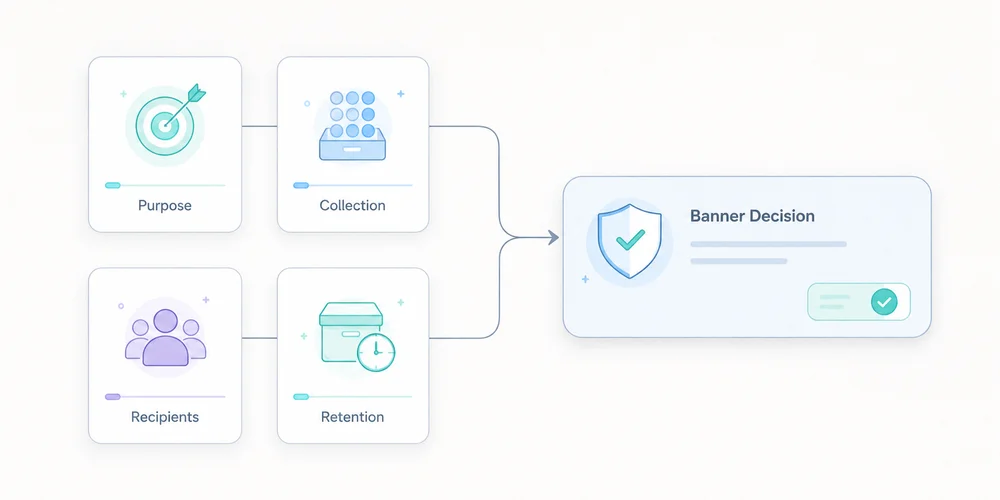
“Cookieless analytics” is often shortened to “consent-free analytics” and then to “no cookie banner”. Those statements are not equivalent. A tool can avoid HTTP cookies while reading or writing information on a device through another mechanism. A product may offer a limited audience-measurement configuration while other modules require a different assessment. And even when analytics fits a strict framework, videos, support widgets, advertising pixels or embedded forms elsewhere on the site may still require consent. The right question is not, “Is the tool cookieless?” It is:Which trackers and processing operations are actually deployed on this site, in this configuration, for which purposes and under which conditions?This is an assessment framework, not legal advice. It must be adapted to the countries, uses and setup involved. Do not confuse three layers 1. Storage or access technology A cookie is one technique. The ePrivacy framework more broadly addresses storing information on a user's terminal or accessing information already stored there, as transposed in national law. Local storage, SDKs, pixels, fingerprinting mechanisms and other terminal access can therefore raise consent questions without a traditional HTTP cookie. Cookieless is a technical characteristic, not a complete legal classification. 2. The ePrivacy tracker regime In France, Article 82 of the Data Protection Act implements the tracker rules. The general principle is prior information and consent for covered operations, with exceptions including operations strictly necessary for a service expressly requested. The CNIL also describes conditions under which certain audience-measurement trackers may fall within an exemption. This is a narrow framework, not a general exemption for all analytics. 3. Personal-data processing under the GDPR Even when a terminal operation does not require ePrivacy consent in a particular configuration, GDPR duties can still apply if personal data are processed. Purposes, legal basis, transparency, minimisation, retention, recipients, transfers, security and rights may still need to be documented. No banner does not mean no processing or no information. The French limited audience-measurement conditions The CNIL states that, to remain strictly necessary for the service and potentially fall within the described exemption, trackers must in particular:be strictly limited to measuring the audience of the site or app; operate exclusively on behalf of the publisher; produce anonymous statistics only; avoid combining the data with other processing; avoid transmitting non-anonymous data to third parties; avoid global tracking across websites or apps.The CNIL also recommends informing users, limiting tracker lifetime, for example to thirteen months without automatic extension, retaining collected information for no more than twenty-five months, and reviewing those periods. Each condition matters. Strictly limited purpose Technical performance, viewed content and navigation problems may fit the described logic. Advertising audiences, CRM enrichment, ad personalisation and cross-service tracking do not share the same purpose. One product interface may offer both. Audit the enabled feature, not only the vendor name. Exclusively for the publisher The provider should not turn the collection into data for its own targeting, profiling or incompatible cross-client measurement. Review the contract, product documentation and subprocessors. A marketing statement is not enough. Anonymous statistics “Anonymous” is a demanding word. Removing a name, truncating an IP address or hashing an identifier does not automatically create anonymity. If a signal still distinguishes or connects a person, use cautious terminology. Ask the vendor to explain transformations and re-identification risk. No global cross-site tracking A shared identifier used to deduplicate people across properties changes the scope. This matters for groups and agencies consolidating audiences. A multi-site dashboard can aggregate indicators without requiring a cross-site person identifier. The checklist before any no-banner promise 1. Inventory the whole site Do not begin and end with analytics. Include:analytics; tag managers; embedded video and maps; support chat; forms; fraud prevention; experimentation; session replay; advertising; social widgets; security and CDN tooling; partner scripts; mobile SDKs where relevant.Run a tracker audit before and after each consent choice, across several pages and journeys. Strict analytics does not neutralise an advertising pixel elsewhere. 2. State real purposes For every component, state what it enables:aggregate audience statistics; campaign analysis; personalisation; advertising; security; interaction recording; support; product experimentation.“Improve the service” is too broad to govern a configuration. 3. Identify terminal operations Document cookies, local storage, session storage, cache identifiers, SDKs, pixels, device characteristics, consent signals and withdrawal. A scanner showing no cookies does not close the assessment. 4. Inspect collected data and transformations The data collection summary should answer:Is the IP address received, used and stored? Is the full URL transmitted? Is the user-agent raw or reduced? Is a visitor identifier created? Is it stable across days or sites? Are UTM parameters retained? Can free-form events contain text? Which data are aggregated? At what point can a record no longer single someone out?An “anonymous mode” that nobody can explain is not evidence. 5. Review vendor use Ask whether the vendor:acts only as a processor for this collection; reuses data for its own purposes; combines data between customers; produces benchmarks from individual-level data; trains another product; sends data to subprocessors; makes international transfers.Benchmarking can sometimes be designed on separated aggregate data. It still needs to be understood. 6. Verify the exact configuration Documentation may say “can be configured to meet the criteria”. That does not mean your default account does. Keep evidence of:configuration export or screenshots; script version; collection parameters; disabled modules; allowed domains; retention; sharing options; verification date; owner.The CNIL tells publishers to request documentation and operating instructions from providers. 7. Review retention Separate tracker or identifier lifetime, raw events, statistics, technical logs, backups and exports. Test automated deletion. A dashboard retention setting may not cover files exported by your team. 8. Inform visitors Even when consent is not required for a strictly framed measurement setup, the CNIL recommends informing users, for example in the privacy notice. Depending on context, explain purpose, relevant data, general operation, duration, provider, recipients, rights, contact and relevant transfers. “We use privacy-friendly analytics” is not enough. 9. Test refusal and withdrawal Where part of the stack relies on consent:covered trackers must not start before the choice; refusal must follow applicable interface requirements; withdrawal must have an effect; the signal must reach all relevant tags; new pages and components must respect the choice.Test behaviour, not only the CMP appearance. 10. Validate and retain the assessment The controller makes the final decision, with DPO or legal support where appropriate. Record:countries; purposes; inventory; criteria reviewed; vendor evidence; configuration; tests; residual risks; date and owners; review triggers.The answer may differ for a French corporate site, an authenticated app and an international property group. Cookieless, consent mode and no banner Cookieless The term can mean no persistent cookie, no cookie in one mode, alternative storage, identifier-free events, server-derived identifiers or simply no advertising cookie. Ask for the technical definition. Consent mode A consent mode communicates user choices to tags and can change their behaviour. Depending on the product and setup, signals may still be sent without advertising cookies. It helps implement a decision. It does not decide whether no-consent collection is legally permitted, and it does not turn advertising into strictly necessary measurement. No banner This statement can only be assessed across the complete site. It may be reasonable when no non-essential component runs before consent and the audience measurement genuinely meets the applicable framework. It is misleading when based only on the absence of an analytics cookie. Claims to avoidabsolute GDPR or legal-compliance claims; blanket consent-exemption claims; claims that cookie-free analytics automatically remove every banner; claims of official CNIL certification; claims of official CNIL approval; “No personal data” “No legal assessment required”The CNIL explicitly states that a solution cannot present itself as certified or approved by the authority merely because of the audience-measurement self-assessment. More accurate wording includes:“cookieless by default”; “designed for minimal collection”; “can be configured for limited audience measurement”; “exemption depends on purposes, configuration and context”; “users remain informed”; “the complete site stack must be audited”.Precision protects credibility as well as compliance. When a banner remains necessary Depending on applicable law and configuration, consent is generally still relevant for:personalised advertising; retargeting; ad-network sharing; cross-site tracking; profile enrichment; some session-replay uses; non-essential personalisation; third-party embeds with non-essential trackers; analytics beyond a limited measurement purpose.The existing guide to session replay and the CNIL consultation explains why detailed behavioural recording should not be treated like aggregate audience statistics. A simple decision process Case A: strictly limited measurement Minimal collection, no cross-site tracking, no vendor reuse, anonymous statistics, controlled retention, information and documentation. Action: assess and document the local framework, then inspect the rest of the site. Case B: enriched analytics after consent The team wants detailed events, advanced attribution or more persistent identifiers. Action: block the relevant capabilities until consent, transmit the choice correctly and document the processing. Case C: mixed stack Minimal measurement runs by default, with extended modules enabled after consent. Action: separate the modes technically, prevent reporting changes from silently expanding collection, and test every transition. Clear separation is more credible than one setting claimed to fit every use. Conclusion A no-banner promise cannot be inferred from “cookieless”. It follows from an assessment of the complete site, purposes, terminal operations and configuration. Before communicating, verify:every component; purposes; terminal access; data and identifiers; vendor use; configuration; retention; transparency; consent behaviour where applicable; the documented decision.The result may be a no-banner strict stack, a consent-based extended stack, or a clearly separated combination. Quality comes from the distinction, not the slogan. FAQ Is cookieless analytics automatically exempt from consent? No. Assess other terminal operations, purposes, data, identifiers and applicable national law. Cookieless is a technical feature, not a legal conclusion. Does the CNIL certify exempt analytics tools? No. The CNIL provides criteria and a self-assessment tool but says providers cannot present that self-assessment as official certification or approval. Can visitors be informed without a banner? Yes, when consent is not required for the relevant collection, information can be provided in a privacy notice or another appropriate location. It must remain clear and accurate. Do UTM tags prevent an exemption? Not automatically, but their use and combination must remain compatible with the limited purpose, minimisation and absence of cross-site tracking. They must never contain personal data. Who decides whether the site can operate without a banner? The controller makes and documents the decision, supported by a DPO or legal adviser where needed. A vendor alone cannot guarantee the answer for every site. SourcesCNIL, Audience-measurement cookies and consent conditions CNIL, What does the law say about cookies and trackers? Directive 2002/58/EC on privacy and electronic communications EDPB, Guidelines 05/2020 on consent EDPB, Guidelines 2/2023 on the technical scope of Article 5(3) ePrivacy
- 16 Feb, 2026
Cookieless 2026: why SMEs can move faster when analytics stays small
Large organizations often need months to change analytics tools. They have tag managers, consent platforms, data warehouses, agency workflows, advertising pixels, dashboards and historical reporting commitments. SMEs usually have less legacy. That can be an advantage if they keep the migration disciplined. Cookieless analytics is not magic. It is a product and governance choice: collect less, document more clearly, and focus on reports the team actually reads. Why SMEs can move faster SMEs usually have fewer stakeholders, fewer custom tags and fewer legacy dashboards. A small team can audit its measurement stack in a day, remove unnecessary scripts and agree on a simpler reporting model. The advantage is not size by itself. The advantage is decision speed. A founder, marketing lead, product manager and developer can sit together and decide what is genuinely needed for launch. The practical playbook Start with four questions:Which decisions will analytics support each week? Which fields are necessary for those decisions? Which fields belong only in enriched collection? Who owns future changes to the tracking plan?Then implement the simplest baseline possible. Page views, sources, top content, key actions and trend comparison are enough for many SME sites. Campaign details, advanced goals, technical slices and multi-site segmentation should be added deliberately when they create real value. What to avoid Avoid rebuilding the complexity you were trying to escape:installing multiple analytics scripts for the same question; keeping old pixels "just in case"; collecting campaign parameters nobody reviews; adding custom events before the team has defined success; presenting privacy posture as a generic guarantee instead of documenting the setup.Where Pomelo fits Pomelo's launch doctrine is Strict by default and Extended by configuration. That fits SMEs that want useful reporting without expanding the tracking stack unnecessarily; compliance still depends on the site's documented configuration. Strict should answer the baseline questions. Extended should be reserved for richer acquisition, events, goals and technical context. The setting belongs in site collection settings, not inside reports. Sources Sources checked on May 9, 2026.CNIL, Cookies and audience measurement solutions CNIL, Cookies and other trackers Google, Consent Mode overview Pomelo, GDPR audience measurement framework article