Tag: Privacy first
All blog posts with this tag.
- 07 Feb, 2026
Plausible vs Fathom vs Simple Analytics: the 2026 privacy-first analytics comparison
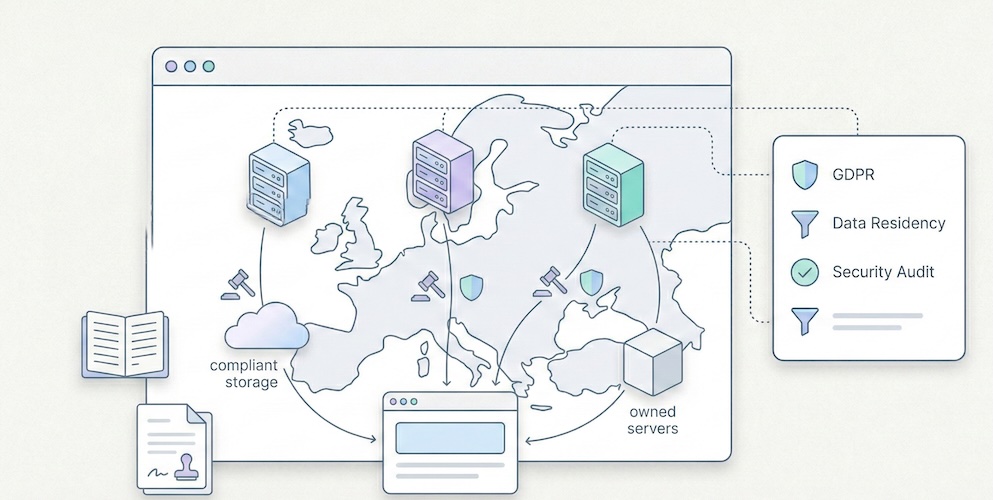
You have decided to leave Google Analytics behind. You understand that "free" comes at a real cost, that GA4's complexity exceeds your actual needs, and that GDPR compliance deserves more than a poorly configured cookie banner. Good. You are part of a fast-growing movement. Now comes the hard part: among the privacy-first alternatives, which one actually fits your situation? Three names keep coming up: Plausible, Fathom and Simple Analytics. They are the most cited, most mature and most credible options in the "frugal analytics" segment. But their differences, often invisible in marketing copy, have very real consequences on your bill, your compliance posture and your daily workflow. This comparison does not aim to crown a universal winner. It provides the factual elements you need to make an informed choice. We verified pricing on official pages, documented actual features, and added two outsiders often overlooked in these discussions: Pirsch and Umami. What these three solutions share Before diving into differences, let us establish common ground. Plausible, Fathom and Simple Analytics share a foundation that radically separates them from Google Analytics: None of them use cookies by default. They do not build advertising profiles. Their scripts weigh less than 5 KB (compared to roughly 45 KB for GA4, according to HTTP Archive measurements). They display all essential metrics on a single page, with no nested menus and no training required. On the legal front, all three claim GDPR compliance without a cookie banner. In practice, the strength of that claim varies, and that is one of the points we will detail below. Finally, all three are independent companies with no major venture capital, funded by their subscriptions. That is a strong signal of long-term sustainability. Real pricing, compared side by side The entry price does not tell the full story. What matters is the cost at comparable volume. Here are the rates verified on each solution's official page as of February 2026. Monthly pricing grid (USD, monthly billing)Monthly volume Plausible (Starter) Fathom Simple Analytics (Simple)10,000 pageviews $9 $15 $15100,000 pageviews $9 (same tier) $15 ~$19200,000 pageviews $14 (Growth) $25 ~$29500,000 pageviews ~$19 (Business) $45 ~$491,000,000 pageviews Custom $60 CustomSources: plausible.io/pricing, usefathom.com/pricing, simpleanalytics.com/pricing. Rates verified February 2026. Key takeaways: Plausible is the cheapest option at low volume ($9/month for 10k pageviews). But pricing rises quickly: the Growth plan at $14 and the Business plan at $19 unlock additional features (more sites, team access, funnels). Fathom offers a single feature set across all tiers, with pricing based solely on pageview volume, starting at $15/month. No free plan. No discounts. Their stated philosophy: the same price for everyone, no promotions ever. Simple Analytics offers a free plan (limited to 30 days of history) and a Simple plan at $15/month. The Team plan ($40/month) adds collaboration and API access. Their billing adjusts automatically based on the three-month rolling average of your traffic. Two outsiders worth knowing Pirsch (based in Germany) offers one of the lowest entry prices on the market: $6/month for 10,000 pageviews, $10/month for 100,000 pageviews. It includes white-labelling and up to 50 domains. Source: pirsch.io/pricing. Umami is open source and fully self-hostable at no cost. It is the only solution in this comparison with zero licensing fees, provided you manage hosting yourself. For those who prefer a managed service, Umami Cloud starts at $9/month. Source: umami.is. Data hosting and location This is the critical point for GDPR compliance. The question is not just "where are the servers?" but "who operates the infrastructure and under which jurisdiction?"Solution Data location Infrastructure Legal entityPlausible European Union (Hetzner, Germany) Owned by European companies Plausible Insights OÜ (Estonia)Fathom Servers in Germany (via AWS EU) Amazon Web Services Conva Ventures Inc. (Canada)Simple Analytics Netherlands European-owned servers Simple Analytics B.V. (Netherlands)Pirsch Germany German servers Emvi Software GmbH (Germany)Umami (Cloud) Variable by plan Vercel/Cloud Umami Software Inc. (USA)Plausible emphasises that its entire infrastructure is operated by European companies. As of early 2026, they report over 16,000 paying subscribers, including 600+ enterprise accounts. Source: plausible.io/enterprise-web-analytics. Fathom uses AWS in the EU region (Frankfurt), but the legal entity is Canadian. Canada benefits from an adequacy decision by the European Commission, which simplifies data transfers. However, for organisations with strict data sovereignty requirements, this is not equivalent to a fully European entity. Simple Analytics is the most explicit about data location: data exclusively in the Netherlands, proprietary servers, no US-based subprocessors. This is the strongest argument for organisations subject to strict sovereignty policies. Pirsch, based and hosted in Germany, offers a comparable alternative in terms of European data localisation. The privacy question All three solutions call themselves "privacy-first". But the technical details matter. Plausible uses a hash of the visitor's IP address combined with the User-Agent and a daily salt to identify unique visitors. The raw IP address is never stored. The hash is renewed daily, which prevents long-term tracking. This is a form of pseudonymisation. Fathom uses a similar hashing approach but adds a routing layer through what they call "unique signatures". Like Plausible, the raw IP is not retained. Simple Analytics stands apart by claiming to collect no personal data whatsoever, including in hashed form. No IP hash, no User-Agent recorded. Their unique visitor counting relies on a different mechanism based on referrers and URLs. This is the most radical approach to data minimisation. This difference has a direct consequence: Simple Analytics can legitimately claim not to process personal data within the meaning of the GDPR, which strengthens the case for consent exemption. For Plausible and Fathom, the question is more nuanced: a hashed IP, even if non-reversible, could be considered pseudonymised data. In practice, data protection authorities (including the CNIL in France and the ICO in the UK) tend to accept these approaches if they meet exemption criteria (no cross-referencing, limited retention, strictly statistical purpose). For more on consent exemption conditions, see our dedicated article: Audience measurement, GDPR and cookie banner exemption. Features: what each one does (and does not do) All these solutions have chosen simplicity. But "simple" does not mean identical. Here are the differences that matter in daily use. Feature comparison tableFeature Plausible Fathom Simple AnalyticsSingle-page dashboard Yes Yes YesCustom events Yes Yes YesGoals / Conversions Yes (advanced funnels) Yes YesMulti-step funnels Yes (Business plan) No NoGoogle Search Console integration Yes No NoE-commerce tracking (revenue) Yes (Business plan) Yes NoGA4 data import Yes Yes NoExport API Yes Yes Yes (Team plan)Email reports Yes Yes YesDashboard sharing Yes (public/private link) Yes (shareable link) YesMulti-site 1 (Starter) / 3+ (Growth) 50 included 5 (Free) / 10+ (Simple)Team members 1 (Starter) / 3 (Growth) 1 (base plan) 1 (Simple) / 2+ (Team)Data retention 3-5 years by plan Unlimited 30 days (Free) / 3-5 yearsOpen source Yes (Community Edition) No NoSelf-hosting Yes (CE, reduced features) No NoWhite-label No (except Enterprise) No NoKey highlights: Plausible is the most feature-rich of the three. The Google Search Console integration is a significant advantage for SEO: it lets you see search queries directly in the analytics dashboard, without switching tools. Multi-step funnels (Business plan) bring it closer to more advanced tools. And being open source reassures organisations that want to audit the code. Fathom stands out with its unlimited data retention policy and the inclusion of 50 sites from the base plan. For a freelancer or agency managing many low-traffic sites, this is a real economic advantage. Their infrastructure is built for scale: they claim to handle sites with one billion pageviews per month. Simple Analytics bets everything on simplicity and absolute privacy. Their "Mini Websites" feature lets you see the exact pages that referred your site (for example, a specific tweet), which other solutions do not offer. Their built-in AI tool lets you query your analytics in natural language. Script weight and performance impact For a website, every kilobyte of JavaScript affects loading time and Core Web Vitals. This is a criterion that should not be overlooked, especially if SEO is a priority.Solution Script weight Estimated impactPlausible < 1 KB NegligibleFathom ~2 KB NegligibleSimple Analytics ~6 KB Very lowPirsch < 1 KB (or server-side) Negligible to zeroGoogle Analytics (GA4) ~45 KB Measurable (LCP, FID)All solutions in this comparison have a negligible performance impact, especially compared to GA4. The advantage goes to Plausible and Pirsch, whose scripts are lightest. Pirsch also offers server-side integration (via API or SDK), which eliminates client-side JavaScript entirely. To understand in detail why analytics script weight matters for SEO, see our article: Myth: you need Google Analytics for SEO. Which tool for which profile? Rather than declaring a winner, here is a decision guide by real-world situation. You are an indie developer or maker with a SaaS You manage one or two projects, traffic is moderate (< 100k pageviews/month), and you want a tool that installs in 30 seconds. Best pick: Plausible (Starter at $9/month) for the best value at the first tier, open source, and Search Console integration. Alternative: Pirsch ($6/month) if budget is very tight, or Umami (free) if you are comfortable with self-hosting. You are a freelancer or agency managing 10-30 client sites Volume per site is low, but the number of sites is high. You need separate dashboards and simple reporting. Best pick: Fathom ($15/month, 50 sites included). No competitor includes as many sites in the base plan. Unlimited data retention means you never lose client history. Alternative: Pirsch, which also offers 50 domains from the first plan. You are an SME with strict compliance obligations (DPO, processing register) The question is not price but demonstrating compliance to your DPO or supervisory authority. Best pick: Simple Analytics, for the "zero personal data" argument. This is the easiest position to defend in a data processing register. Alternative: Plausible, whose 100% European hosting on European-owned infrastructure (not AWS) strengthens the sovereignty case. You are an organisation that needs funnels, e-commerce tracking or advanced analysis You have outgrown a minimalist dashboard. You need multi-step conversion tracking. Best pick: Plausible (Business plan). It is the only solution in this comparison that offers advanced funnels and e-commerce revenue tracking while staying within the privacy-first paradigm. For a broader view including GA4 and Matomo, see our general comparison: Google Analytics, Matomo and frugal analytics: a 2026 guide to choosing. Total cost: beyond the sticker price The monthly fee is only part of the equation. Here are the hidden costs (or avoided costs) to factor into your calculation. Costs avoided compared to GA4: no training required (GA4 often requires days of training), no consultant for configuration, no Consent Management Platform to maintain if you qualify for the consent exemption, no legal risk from data transfers to the United States. Migration cost: Plausible and Fathom let you import Google Analytics history. Simple Analytics does not. If historical continuity matters to you, this is a consideration. Self-hosting cost (Plausible CE, Umami): free in licensing, but factor in maintenance time, updates, and server cost (roughly $5 to $20/month for a VPS depending on volume). And Plausible Community Edition does not include all cloud features (funnels, e-commerce, Sites API). To go deeper on the real cost of analytics, our article on data obesity explains the economic consequences of over-collection: Data obesity: why your SME does not need Big Data. Final summary tableCriterion Plausible Fathom Simple Analytics PirschEntry price $9/month $15/month Free (limited) $6/monthEntry volume 10k pvs 100k pvs Unlimited (Free) 10k pvsSites included 1-10+ 50 5-20+ 50Data location EU (Hetzner) EU (AWS Frankfurt) Netherlands GermanyLegal entity Estonia (EU) Canada Netherlands (EU) Germany (EU)IP hash Yes (daily) Yes No YesOpen source Yes (CE) No No Yes (partial)Retention 3-5 years Unlimited 30d - 5 years UnspecifiedGA4 import Yes Yes No YesFunnels Yes (Business) No No Yes (basic)GSC integration Yes No No YesScript < 1 KB ~2 KB ~6 KB < 1 KBFAQ Plausible, Fathom or Simple Analytics: which is cheapest? It depends on volume. For under 10,000 pageviews per month, Pirsch is cheapest ($6/month). Among the three main solutions, Plausible is most affordable at low volume ($9/month for 10k pvs). At 100,000 pageviews, Plausible and Fathom converge around $15/month. Beyond that, Plausible generally remains cheaper, but its features are spread across multiple plans (Starter, Growth, Business). Is Plausible truly GDPR compliant without a cookie banner? Plausible is designed to work without cookies. Their identification method uses a daily-rotated IP hash, with no raw address stored. Under the criteria set by the CNIL for consent exemption (and similar guidance from the ICO and other European DPAs), this approach is accepted when strictly limited to audience measurement with no cross-referencing with other processing. However, the "personal data" status of an IP hash is subject to ongoing legal debate. The prudent approach is to consult your DPO and document your analysis in your processing register. Is Fathom a good fit for agencies managing many client sites? Yes, this is one of its strongest points. Fathom includes up to 50 sites in every plan, with separate dashboards. Unlimited data retention and automated email reports make it well suited for multi-client management. However, Fathom does not offer white-labelling or per-user permission management on the standard plan. What is the difference between Plausible Cloud and Plausible Community Edition? Plausible Cloud is the hosted, managed service run by the Plausible team (from $9/month). Plausible Community Edition (CE) is the open-source version, self-hostable for free. But CE does not include all cloud features: marketing funnels, e-commerce revenue tracking and the Sites API are excluded. CE is suited for developers who want basic analytics on their own server. Are there solutions even cheaper than these three? Yes. Umami is entirely free to self-host (open source, MIT licence). Pirsch starts at $6/month. And for very small sites, Simple Analytics offers a free plan with 30 days of retention. Beyond these options, it is also worth considering that "cheapest" is not always most economical: ease of installation, infrastructure reliability and company sustainability have real value. A tool that disappears or locks your dashboard when you exceed your quota costs more than a slightly higher subscription.Last updated: February 2026. Pricing and features verified on official solution websites. This article will be updated at minimum every six months.