Why the Era of 'Data Obesity' Is Paralyzing Small Businesses (And How to Break Free)
- 06 Dec, 2025
We were sold a dream. The “Big Data” dream. For the past decade, the promise made to SMB owners, freelancers, and marketing managers has been the same: “The more data you collect about your visitors, the better you’ll sell.”
The reality in 2025? It’s often the opposite. Tools have become bloated, data piles up unread, and decisions are slower than before. This is what we call data obesity: the accumulation of data that doesn’t serve decisions, but costs you in time, money, compliance, and performance.
In short:
- Too much data kills decisions: information overload clutters dashboards and paralyzes action.
- The “Vanity Metrics” trap: you track flattering curves instead of focusing on what actually drives revenue.
- A triple cost: technical (slower site), legal (GDPR), and trust (visitors refusing tracking).
- The solution exists: frugal analytics — measure less, decide better.
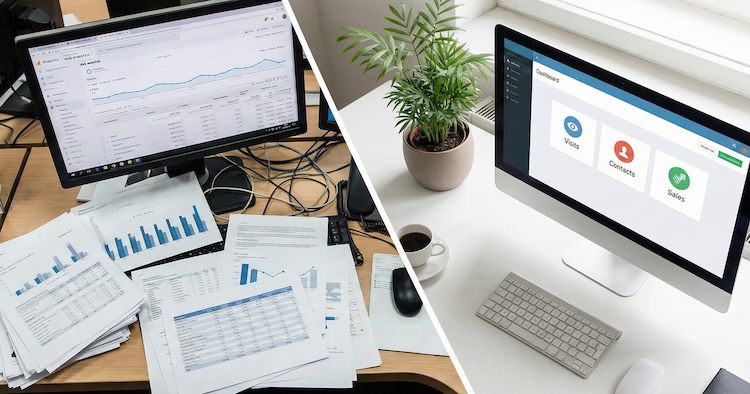
1. The “Dashboard Nobody Looks At” Syndrome
Open your current analytics tool. In under 10 seconds, can you tell:
- whether your week was good?
- which page generated the most leads?
- which traffic source is performing best?
If the answer is no, you’re not alone. You’re in the overwhelming majority.
Big Data Isn’t for SMBs
According to Eurostat, only 8% of EU enterprises analyze Big Data. That number drops even further for small businesses. The “Big Data for everyone” promise didn’t hold: SMBs don’t have the teams, budgets, or time to exploit massive, complex datasets.
→ Source: Eurostat – Big Data analysis by enterprises
Yet these same SMBs end up with tools designed for 20-person data teams. GA4 offers hundreds of reports, dozens of dimensions, customizable explorations. For a 2-person marketing team (or a solo founder), it’s like getting an airliner cockpit when all you need is a car dashboard.
The Choice That Paralyzes
The abundance of options, reports, and dimensions creates user fatigue. This is a well-documented phenomenon in behavioral science: choice overload. The more options you have, the less capable you are of choosing — and the less satisfied you are with your choice when you make one.
→ Source: The Decision Lab – Choice Overload Bias
Applied to analytics: more information ≠ better decisions. On the contrary, too much data leads to inaction. You close the tab and fly blind.
2. The Race for “Vanity Metrics”
In many small businesses, the metrics sitting at the top of dashboards are also the ones least useful for decision-making:
- pageviews (without knowing which pages convert),
- total session count (without distinguishing prospects from bots),
- bounce rate (an ambiguous metric, often misinterpreted),
- visitors by country (rarely actionable for a local business).
These metrics flatter the ego — “we had 10,000 visits this month!” — but they say nothing about a site’s actual performance.
The 3-Question Test
For a small business, a useful dashboard should answer three questions:
- How many people are discovering my site? (acquisition)
- Which pages generate the most inquiries or sales? (performance)
- What does that represent each week? (results)
If your tool can’t answer these immediately, it’s pulling you away from your main goal: understanding what works so you can grow your business. We’ve detailed which metrics to keep (and which to ignore) in our guide to The “5 KPIs” Method.
3. The Hidden Cost of Complexity
Data obesity doesn’t just cost time. It has three concrete costs that most businesses underestimate.
3.1 The Technical Cost: A Slower Website
Traditional analytics tools often ship heavy scripts that degrade Core Web Vitals — the web performance metrics Google uses as a ranking factor.
An independent audit by Bejamas shows that third-party scripts (analytics, chat widgets, marketing pixels) can significantly slow down page loads, with analytics scripts often leading in main-thread blocking time.
→ Source: Bejamas – How Popular Scripts Slow Down Your Website
The GA4 script weighs approximately 45 KB compressed. Frugal alternatives weigh between 1 and 6 KB — 7 to 45 times lighter. As we explain in our article on SEO without Google Analytics, this difference directly impacts Core Web Vitals and therefore potentially your search rankings.
Slower sites = fewer conversions = less revenue.
3.2 The Legal Cost: GDPR Risk
The more signals you collect — precise geolocation, cross-page navigation, technical fingerprinting, per-page session duration — the higher your legal exposure. Every piece of data collected is a piece of data to protect, to document in your processing registry, and to justify during an audit.
European Data Protection Authorities — including the French CNIL — explicitly provide a consent exemption for audience measurement tools that meet strict frugality conditions. Tools that collect the bare minimum can operate without cookie banners, without prior consent, and with a dramatically reduced compliance burden.
→ Source: CNIL – Audience measurement solutions
We’ve detailed the conditions for this exemption in our dedicated guide. This is probably the most underappreciated argument for frugal analytics: by collecting less, you mechanically simplify your compliance.
3.3 The Trust Cost: Visitors Who Refuse
Another side effect of traditional analytics: cookie banners.
According to data from European regulators, cookie refusal rates have risen significantly since enforcement began in earnest. Estimates suggest that a site using a classic cookie banner loses between 30% and 50% of its actual data.
→ Source: CNIL – Cookie action plan impact evaluation
In some sectors, ad blockers and script blockers amplify the loss further. Result: your dashboard is lying to you. It only shows a fraction of your real audience — sometimes only 50 to 60%.
A cookieless tool, by design, doesn’t depend on consent. It measures 100% of visits from the moment of arrival. That’s a business argument, not just a legal one.
4. The Solution: Frugal Analytics
Frugal analytics isn’t about measuring less out of laziness or ideology. It’s about measuring better, by focusing on what:
- concretely helps you make decisions,
- respects visitor privacy,
- doesn’t slow down your site,
- doesn’t create legal friction.
What It Changes in Practice
| Before (Data Obesity) | After (Frugal Analytics) |
|---|---|
| 200+ metrics available | 5-7 actionable KPIs |
| Dashboard opened once a month (and closed immediately) | Dashboard checked weekly, understood in 30 seconds |
| Mandatory cookie banner, 40% data loss | Cookieless, 100% of visits measured |
| 45 KB script, Core Web Vitals impact | 1-6 KB script, negligible impact |
| Complex GDPR compliance (CMP, registry, proxying) | Consent exemption, simplified compliance |
| 40-page monthly report | 10-line results-oriented report |
Frugal analytics is the equivalent of seasonal cooking: fewer ingredients, better chosen, better prepared. The result is superior to accumulation.
The Core Principles
- Collect only what drives decisions. If a data point wouldn’t change your actions, don’t collect it.
- Simplify to democratize. A dashboard the founder understands is worth more than a report only the data analyst can interpret.
- Respect by design. Compliance shouldn’t be a bolt-on (“let’s proxy GA4 to get compliant”) but a prerequisite (“let’s choose a tool that’s compliant natively”).
- Measure performance, not people. Aggregated trends (popular pages, traffic sources, conversion rates) are more useful and less risky than individual-level tracking.
5. Where to Start
If you’re convinced your current analytics is too complex, here are the first three steps.
Step 1: Identify your 5 KPIs. Use the 5 KPIs method to define the only metrics that matter for your business. If an indicator doesn’t pass the test “would I change how I work if this number moved?”, remove it.
Step 2: Evaluate your current tool. Compare it honestly against the alternatives. Our analytics tool comparison details the strengths, weaknesses, and pricing of each family (GA4, Matomo, frugal).
Step 3: Test. Most frugal solutions install in 2 minutes (one script to paste) and offer a free trial. Run both tools in parallel for a month. Compare: which one gives you an answer faster?
Conclusion: Put Your Analytics on a Diet
The era of collecting data “just in case” is behind us. Regulation, web performance, and common sense all converge on the same conclusion: less data, better chosen, is better for everyone — for the business, for visitors, and for the web.
For 2026, the best strategy for an SMB isn’t adding dashboards — it’s removing them.
Less noise. Less friction. More concrete decisions.
Frugal analytics means putting data in service of the business, not the other way around.
FAQ: Understanding Frugal Analytics
What is frugal analytics? An approach to audience measurement that limits collection to the strict minimum needed to make business decisions. It’s built on three principles: collect only what drives action, prefer aggregated data over individual profiles, and choose tools that are compliant by design (no cookies, no user profiles).
Which metrics should I absolutely keep? Unique visitors, traffic sources, top pages, key events (CTA clicks, form submissions), and conversions. These 5 metrics are enough to steer a brochure site, a blog, or a small e-commerce store. Everything else is bonus — or noise.
Can you do frugal analytics with GA4? Technically yes, but it requires advanced expertise: disabling granular collection, configuring consent mode, proxying data for GDPR compliance, and building custom reports limited to essential KPIs. For most SMBs, it’s simpler and lower-risk to choose a natively frugal tool.
Is frugal analytics enough for e-commerce? For a small e-commerce site (under 1,000 orders/month), yes. The 5 essential KPIs cover acquisition, engagement, and conversion. For e-commerce with multi-channel attribution, retargeting, or advanced segmentation needs, a more comprehensive tool (Matomo, GA4) will be necessary — but the frugality principle still applies: start with the essentials, and add complexity only if it’s justified.
How many businesses actually use Big Data? According to Eurostat, only 8% of EU enterprises analyze Big Data. For SMBs, the number is even lower. The vast majority of small businesses don’t have the teams, tools, or need to collect data massively. Frugal analytics is the approach suited to this reality.